Showing posts with label Multiplication & Division. Show all posts

Thursday, 1 February 2018

Multiplying Decimals

As part of our Unit of Inquiry exploring forces, today we were going to find out how much we would weigh on different planets- the kids love it! 

Part of that requires multiplying their body mass with decimals.

So, to better understand what we will be doing with the numbers, we began with this lead in:
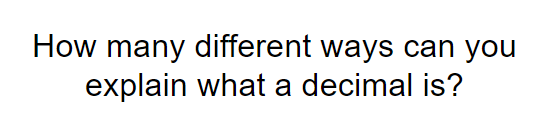
We used the think-pair-share strategy.  Firstly the children jotted down different ways. They then shared with their table group and then we discussed and shared ideas as whole class.  Some of the key understandings included:


We have done this a few times over the year and each time additionally unique perceptions are shared which I find really interesting. I can see how some children's conceptual understandings and abilities to express have expanded and deepened. 


The whole class sharing raised some interesting discussions such as a child sharing how decimal numbers are like negative numbers.  

- Are they? What do we think about that?

Some of us agreed, some disagreed and many were unsure.

Another asked: Can we have negative decimals?

- Can we?

We thought of having a temperature of   - 1 . 5 ° C

Does this prove we can have negative decimals?

Does this mean a decimal is a negative number?

A student shared a theory that: 


This really got us wondering: Can a demoninator be zero?

We chatted about what this might mean- Can we have zero whole parts?  Could this represent a decimal as a negative number?


It was a very interesting thought and I explained that we will definitely come back to this in a few weeks when we explore negative numbers. 


Some of us still weren't 100% sure about decimals being negative numbers or not and that is ok. I think it's good to keep wonderings floating in our minds to think more about later. 


Having tuned our minds back into what a decimal is, we then looked at the following: 
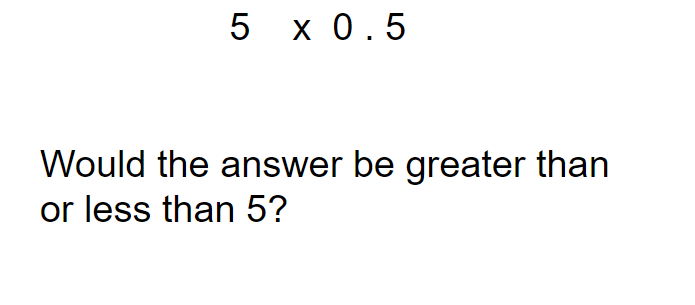


I posed this question to help build number sense and to also value creating theories which we are always doing. 

We showed with thumps up, down or sideways what we our theory was.

There was a mixed initial thought to this.


To help each of us find out for ourselves, the following was posed: 


Asking 'How many different ways......' is a great way to encourage deeper thinking and creativity.

If we ask children to think of one way / one answer, we are limiting their potential to discover different ways of thinking.

Again, we used the think-pair-share routine. 
It was interesting to be able to walk around and chat / observe the different ways the children were trying to visualise it. 


One children shared a great hypothesis:

When we multiply numbers, the answer is bigger so my theory is that the answer to 5 x 0 . 5 will be bigger.

This completely makes sense and I love how she has drawing upon prior conceptual knowledge to create and test a theory.


After a while, the children shared with ther table partners their visual ways. Each table group were asked to select one of the visualisations that they thought the whole class would benefit from seeing. 


Together we discussed the following shared:


We appreciated all the different ways we could visualise the numbers.

We then repeated with a larger decimal:

Again, we first estimated and then tested by visually drawing what it looks like in different ways.

Some of the table sharing included:


We really loved the creative story behind the one below. He explained how there were 5 whole people at the airport and each carried a bag that was 0 . 25 of their body mass:


Valuing creativity and visualising in maths can greatly help children to make stronger number sense like these examples show. 


Lastly, the children created and visually showed their own number sums. Afterwards, they shared and discussed these with their table partners:


Some wanted to challenge themselves further by multiplying a decimal with a decimal to see what it looks like:


And this student found it very interesting to discover how small the number would be when multiplying 5 by 0 . 0000002. We giggled about it being about half the size of a ladybird's poo :P


Before moving on to multiplying the gravitational force of our mass to see how much we would weigh on different planets, I asked if we had some wonderings we wanted to explore next week and so we have the folllowing to find out about: 


I think this has helped us launch into some really interesting wonderings to explore that will further help develop our number sense with decimals and fractions. 


Sunday, 10 December 2017

Peer Teaching: Multiplying Decimals

The Power of Peer-Teaching

We have been inquiring into multiplication strategies and analysing which are more effective than others.

We are now at a point where we continue to add wonderings to our wonder wall about how we could apply those strategies to decimal numbers.


So, today we combined our wonderings of multiplying decimals with visualising what we are doing when we multiply them.

We had groups of 4 and we began using the 'chalk talk' visible thinking routine. In this routine, a large paper is placed in the centre of the group. Each member writes their ideas, wonderings and understandings on the paper at the same time. It is a silent discussion. The members are encouraged to read what others have written and respond by helping them understand, ask a question for clarification or to add on their idea etc.  It is a powerful strategy that ensures each child has an equal amount of 'talk time'; it also allows each child to have an opportunity to collect their thoughts and think how to best communicate their understandings.

To tune into our learning today, we did a 'chalk talk' about decimals. Sample below: 


After our chalk talk, as a class we shared some ideas that emerged. We could only share what someone in our group had shared. We use that strategy a lot especially with 'talk and turn'. I like to think that if the children are encouraged to only share the ideas of others, then they start to listen more intently to their partners. Some very interesting discussions about decimals emerged and we added some more wonderings to our wonder wall to investigate later.

I then posed the question:

How is visualising numbers helpful?

Turn and talk.

The children shared some of their understandings with their partner and then we discussed as a whole class some things our partners told us that we thought were interesting.

From these routines, we had already tuned into what our learning will involve today:

1. Decimal numbers

2. Why we should value visualising numbers.


We often peer teach in our class and we constantly reflect on our peer teaching so we are now at a point collectively where we understand how peer teaching is helpful to our own learning and we are using much more effective and creative strategies when we do it. 

I explained how we are going to inquire into different ways we can visualise multiplying decimals. 

Each group member was to watch a YouTube that explains a different strategy for multiplying decimals.  It was their responsibility to understand the strategy well because their group members will be depending upon them. This sense of responsibility to others instantly engages the children. 

I showed the steps on the data screen that we would follow:


Inquiring Into How To Multiply Decimals


Step 1: Watch and learn

Step 2: Prepare: How will you teach the strategy?
What could you do to engage your group?
Be creative in your approach.

Step 3: Practise teaching the strategy by yourself.
Reflect on what you could do to improve.

Step 4: Teach your group the strategy

Step 5: Ask for feedback from each group member on how well you taught
the strategy.
Each group member will use the '2 and 1' feedback routine:

           ° Two things you did well
           ° One thing you should focus more upon next time you peer
              peer teach

Partner A
Partner B
Partner C
Partner D

Need: 
Base 10 materials

Need: 
Hundred grids

Need: 
Hundred grids

Need: 
Only whiteboard


From the beginning and throughout, every child was completely engaged in their learning. Lots of creative ideas emerged and lots of reflecting happened as they thought about effective ways to teach their group members.

Samples of what the peer teaching looked like:


Listening to the '2 and 1' feedback the children were providing to each other about their effectiveness in teaching was formative to me, but more importantly informative to the children who will be able to expand upon that in future peer-teaching activities.


We grouped together at the end for an oral reflection.

I asked:   What do we think or feel about our learning today?


All the children felt proud in what they had achieved. A lot commented on how they deepened their understandings of what decimals are or what happens to decimal numbers when we multiply them. Others remarked on how they could evaluate the effectiveness of some of the strategies compared to others. Everyone agreed that visualising was very helpful to understand what we are doing when we multiply decimals. A few commented on how they learnt more creative ways to peer teach.


Finally, all the children agreed that they really enjoyed the learning and that is always key to effective learning and mores to help children develop their passion for mathematical thinking.


Monday, 13 November 2017

Lead In to Multiplication Inquiry

To begin our new unit inquiring into multiplication, I wanted to find a way where I could gain an informal glimpse of where each child was already at with their conceptual understanding and at the same time give them an opportunity to rethink what they already know. 

So, I posed this question:


The children wrote their ideas on a shared paper (so that they could be perhaps be inspired by other ideas being generated in their group). 


To help encourage some diverse thinking, we were reminded how visualising in maths is a key element, so how could we visually show what multiplication looks like.


This served as a very useful pre-assessment to help gain an insight of where each child was at with their conceptual understanding of multiplication.


After some time, we then chose two ideas we had and shared those with our group. This generated some interesting discussions and helped with some misconceptions a few of us were harbouring.


We then swapped our paper to the next group. They read through the ideas and then drew a smiley face beside one of the ideas they found interesting.


The children found it interesting to see what their classmate had found interesting about their understandings and found out orally why they thought so.


Our collective understandings:


We then discussed as a class what the 'big ideas' were that we understood about multiplication.  We had a good understanding that multiplication is repeated addition and some shared the connection with division.  When one student theorised that multiplication sums are the same, giving the example of 3 x 7 = 7 x 3, another student questioned that. 

To help with this wondering, I drew the following on the board:


Which does this represent?   3 x 7    or   7 x 3?

Most of us thought it represented 3 x 7 and a few of us thought   7  x 3

Some children were asked to share their reasoning and eventually, as a class we concluded it must represent   7 x 3 because 'the times symbol represents groups of'.  With this situation we are looking at 7 groups of 3, so it must represent 7 x 3. 

We then sketched what  3 x 7 would look like on our paper to help us solidify this understanding.


As a provocation to help raise curiosity and spark wonderings to explore in our unit, the following was posed: 


We used the 'think-pair-share' routine.  We spent about 10 minutes thinking of different possible strategies and were encouraged to try to also create our own. The strategies didn't need to be effective, we were more importantly trying to find as many different strategies as we could. 

We then shared and discussed these with our group. Lots of great discussions took place especially with the more creative strategies they made. 

Our groups then decided which of these strategies worked and if so, they published them and added them to their group poster.

When we completed our posters, we passed them around to see other strategies others in our class came up with and we discussed a few of these together as a whole class.  


For our reflection, we had some time reflecting our learning in our maths diaries.( Link to Maths Reflection Diaries )  


Using our reflection thoughts, we shared these with our group and then as a whole class we came up with the following big ideas:


This has also sparked some interesting wonderings which we will use in the unit to find out about:


Creating provocations to being number units can be a bit challenging to design. It needs to be able to cater to a broad range of different understandings and to also spark lots of wonderings which will form the inquiries.  Looking at our initial wonderings, I think this provocation was quite successful. The children were really engaged and enjoyed the creativity aspect of creating their own strategies. 


Once we have begun exploring different strategies for multiplication and begun evaluating them, I'm sure they will enjoy this creative challenge I did last year with my class: