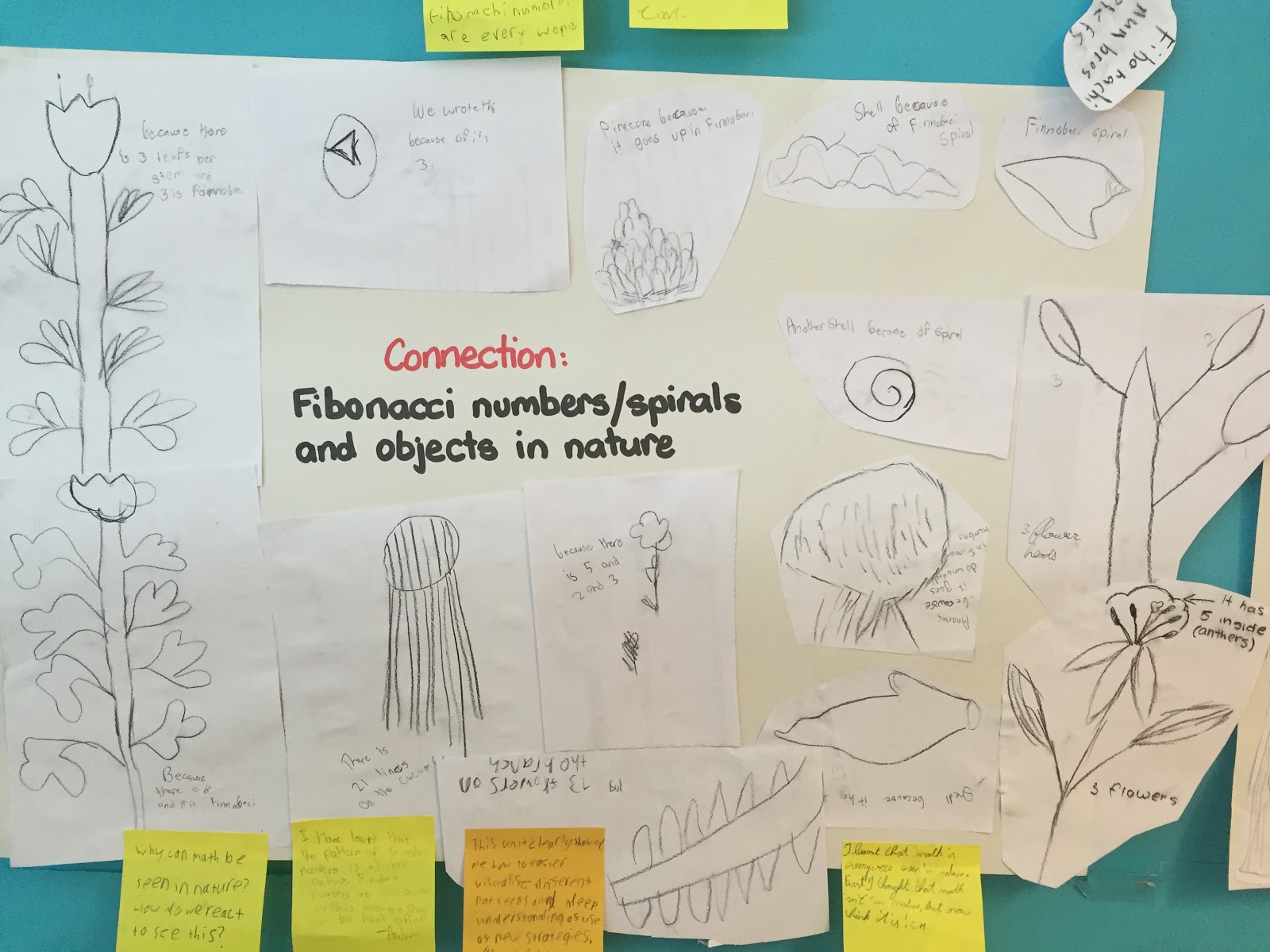
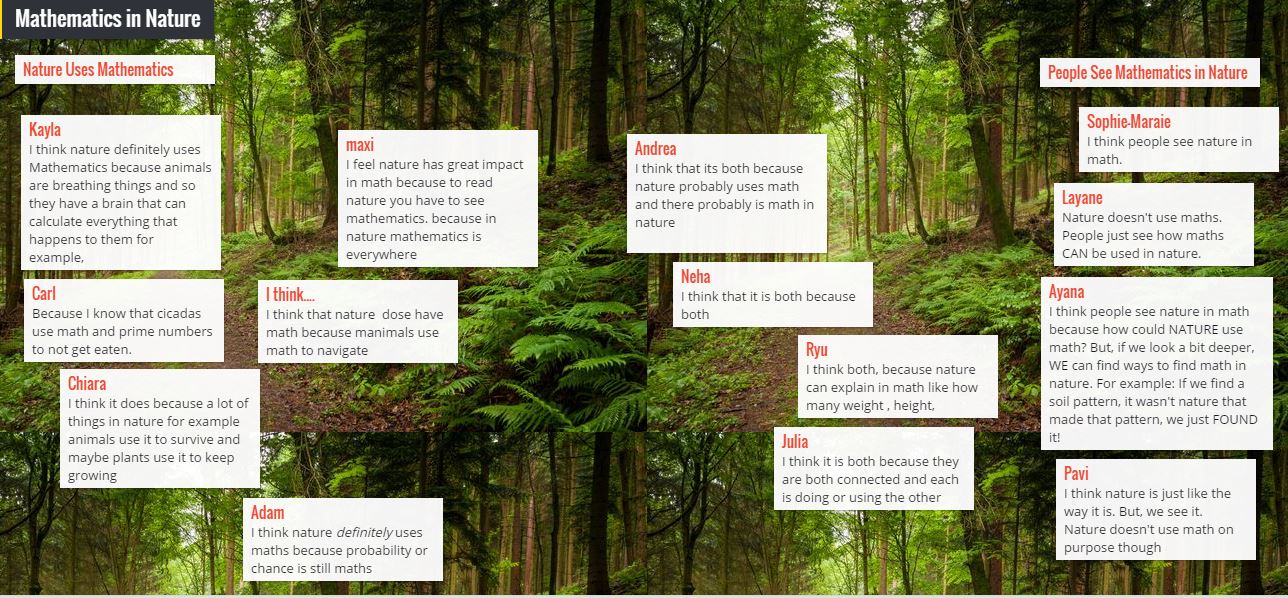
To provoke some lead in thoughts to our enquiry into the Fibonacci numbers and the Golden Ratio, we used Padlet to first think about:
What connections exist between maths and nature?
A strategy I think is useful in discussing is:
What thought was shared that you hadn't thought of before or perhaps made you think deeply about? Was there a thought that made you wonder?
Using this strategy, children are then asked to think beyond their own understandings and to really see and think about others.
After discussing these new ideas, our next padlet was an opinion line.
At one end: Nature Uses Mathematics
At the other end: People See Mathematics in Nature
The children placed their theory along the Padlet to show where they stood on this.
Looking at where we placed our theories, what do we notice?
- It's fairly evenly split.
- The same amount of people agree strongly with both theories.
- No one is 50-50. Even those in the middle still are swayed to one idea or the other.
Again we discussed:
What thought was shared that you hadn't thought of before or perhaps made you think deeply about? Was there a thought that made you wonder?
We then looked at this number pattern.
To arouse some additionally curiosity, I explained how this is probably the most famous number pattern ever.
It's a number pattern that makes people wonder a lot about the role maths plays in nature.
We had some time trying to figure out the pattern and then continued making it. One or two children needed some extra support to determine how we add the previous number to create the next.
We shared what our ideas of how the pattern continued up to 377.
From our recent prime / composite numbers enquiry, the children have been really getting into discovering patterns, so we had some time to play and experiment with them to see what they could discover. Children then shared strategies - both successful and 'un'succesful they used to see if they could find number connections. Some interesting discoveries were shared, but equally important was children sharing the strategies they tested which didn't show connections / patterns as this helps us to learn what we can do to find patterns.
Have we seen this number sequence before?
Two hands raised.
What could you tell us about it?
They explained how they had seen it before. but that's all.
I have a student who is learning Italian after school and since Fibonacci was Italian, I had her read the slide for us (Had google translated it into Italian) and then we tried to infer what each sentence meant in English:
For our next slide, we asked her to translate it into Italian for us:
We discussed what we had read and I added how mathematicians in around 700 AD had first experimented and thought about this number sequence, but when Fibonacci was introduced to it, he played with the numbers in a different way and had spread his findings to Europe so that's why they are called the Fibonacci numbers.
A student suggested we should call them the Hindu-Fibonacci numbers. We liked that idea a lot.
So, what had he done to these numbers to make them named after him?
He proposed an interesting problem for himself to solve which was:
This was a good head scratcher.
I explained how there are probably better ways to visually solve the problem so think about it and don't just follow the displayed idea.
Loads of great mathematical reasoning discussions took place in trying to solve this amongst the partners.
Encouraging children to estimate numbers is really important for their number sense development, so midway we predicted how many pairs of rabbits we thought we might end of with at the end of the year.
Some predicted it would be in the thousands and others felt it would be a lot less.
A few of us shared strategies they used to estimate the final amount which helped those who had over-estimated to see the reasoning behind it.
Time constraints meant we paused with this problem. (We had brought in fruit, vegetables and flowers for our investigation today and as these would wilt soon we needed to move on)
We did though discover the connection between the number of pairs of rabbits each month and the Fibonacci sequence.
We decided we would come back to finishing the problem another day.
We did a gallery walk to see the different approaches partners had taken in trying to visually solve the problem.
We discussed those we thought were effective and some we thought weren't so effective and why.
Some samples:
In discussion, we did think it was interesting how the Fibonacci sequence appeared, but we also acknowledged that this wasn't realistic. One of us who has rabbits shared her understanding of the true breeding habits of rabbits.
(In my own reflection, I don't think I'd introduce this to future students. It IS unrealistic. I thought introducing the historical sense of Fibonacci publishing his findings and thus popularising the Fibonacci numbers in Europe would be beneficial. But because it is so unrealistic, it seems like a forced connection of how the Fibonacci numbers are found in nature and so by doing this, it has probably taken away some of the true wonders we were about to embark upon.)
Looking again at the Fibonacci sequence, we had some time to ourselves to discover any patterns or connections that emerge when we square each number:
Lots of great trial and errors took place in our investigations.
One student shared the following discovery:
We wondered if this pattern would continue for infinity.
We thought we need to test this by continuing the pattern more so we did (in pairs) and we found that it did seem to continue on and on without being interrupted.
So, what does a square number look like?
We drew our ideas of what some of those square numbers look like and shared our understandings.
If we placed each squared Fibonacci number together in a pattern form, what possibilities could we have?
In pairs and using grid paper, the children tested different ways we could do this.
We started with drawing a square 1 by 1 cm and then drew another (because the second number in the sequence is also 1 squared).
Where could we place the 2 squared square?
Where could we place the 3 squared square so it joins the others?
We had some possibilities and most found a connection:
We can use the length of the previous square (or squares) to attach the next squared number!
What have we shown?
- the area of a rectangle!
Exactly.
Let's see how many different ways we can measure the area of the rectangle based on what we have drawn.
- We can multiply the lengths: 13 x 8
- We can count each square and find the total
- We can add 1 squared + 1 squared + 2 squared etc
Which is the most fastest approach?
- multiplying 13 x 8
Which approach shows the connection with the Fibonacci numbers?
- Adding each squared number
Do we think we could continue adding each squared Fibonacci square to this rectangle for infinity with the new squares always adding perfectly to the others?
We thought we could.
Let's start at our first square we drew.
Let's use our eyes to follow how our pattern forms.
What do we notice?
- It forms a spiral.
Exactly.
We then drew a spiral starting at our first square in the middle.
I explained how this spiral has a few special names:
- Fibonacci spiral
- golden spiral
- golden ratio
Also, the rectangle is often called the golden rectangle.
- Why is it called the golden rectangle?
Great question. Why do we think?
- Because gold is special this must also be a special rectangle.
- Gold is hard to find so maybe this is a hard rectangle to make?
- Maybe it is a perfect rectangle just like the equilateral triangle is called a perfect triangle?
So, what about the golden spiral?
Why might it have that name? What theories do we have?
- Maybe people think it is the best spiral.
- It might be a perfect spiral?
- Like gold perhaps people really like it when they find it?
These are some great theories.
We should try to find this out.
We recorded our wonderings and theories on our wonder wall for next week.
A lot of genuine intrigue has been created and that will help propel our enquiries next week. :)